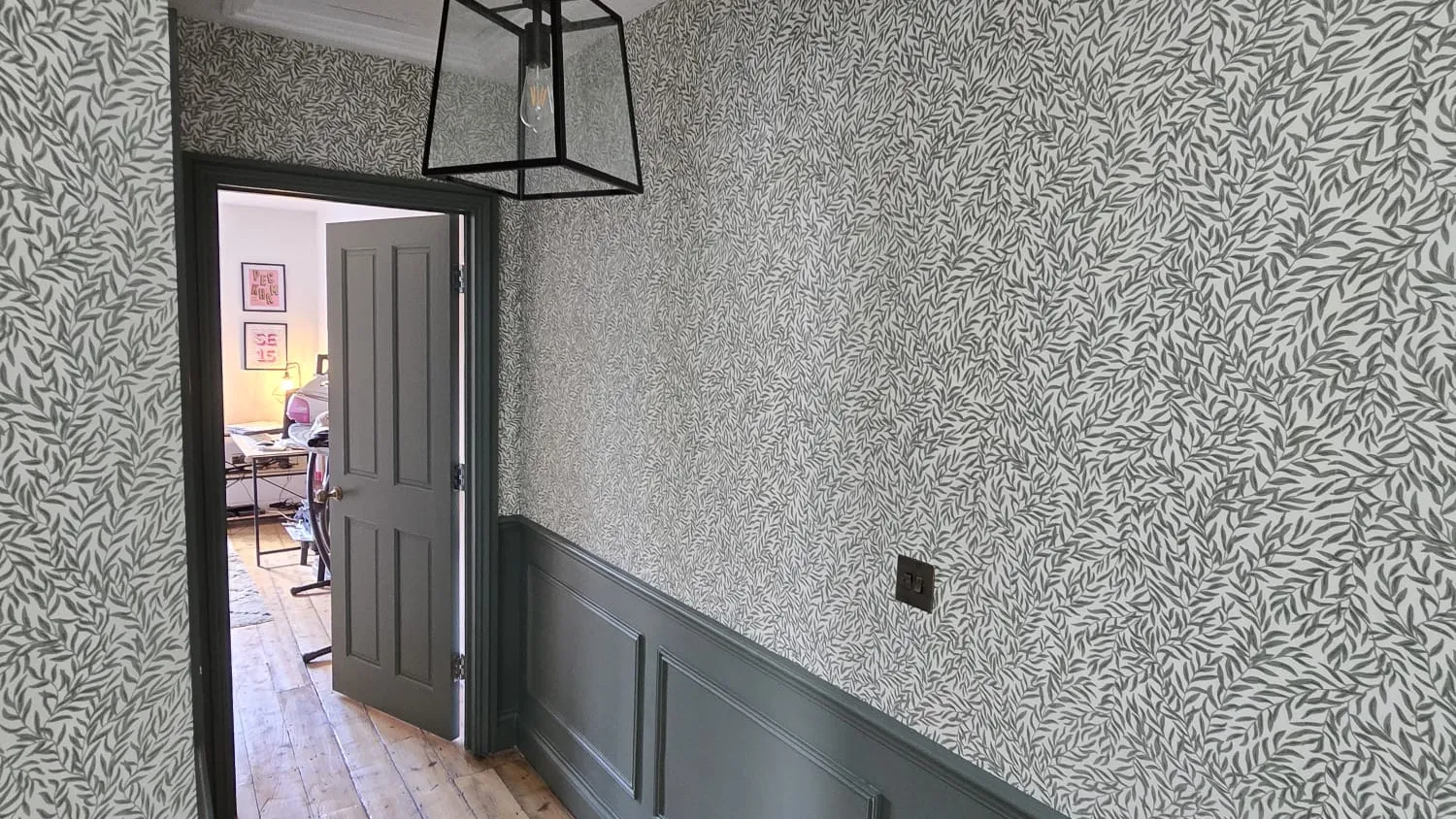
The best hallway wallpaper ideas treat the hallway, stairs and landing as one space. Carry one paper from the front door to the top of the stairs, or hang paper above a dado with paint below where bags and buggies knock the walls.
Below are seven hallways, stairwells and landings our team has papered in London homes, and what each one shows. If you’d rather have yours hung for you, see our wallpaper installation in London.
Why the hallway, stairs and landing should be planned together
In most London houses and maisonettes you can see the hallway, the stairwell and the landing in one look from the front door. Paper one and leave the others plain, and the eye stops at the change, so decide on all three before you buy a roll.
That doesn’t mean one paper everywhere. It means a plan: where the paper starts and stops, what goes below the dado, and which wall the pattern is centred on.
Most schemes we hang fall into one of these:
- One paper throughout, from the front door to the landing. The calmest option, and it makes a narrow hall read as one room.
- Paper above, paint below, split at a dado rail or panelling that climbs the stairs at the angle of the handrail.
- One bold wall: a statement paper on the stairwell or landing, with the rest painted in a colour taken from it.
7 hallway wallpaper ideas from our own jobs
1. A small leaf pattern above dark painted panelling
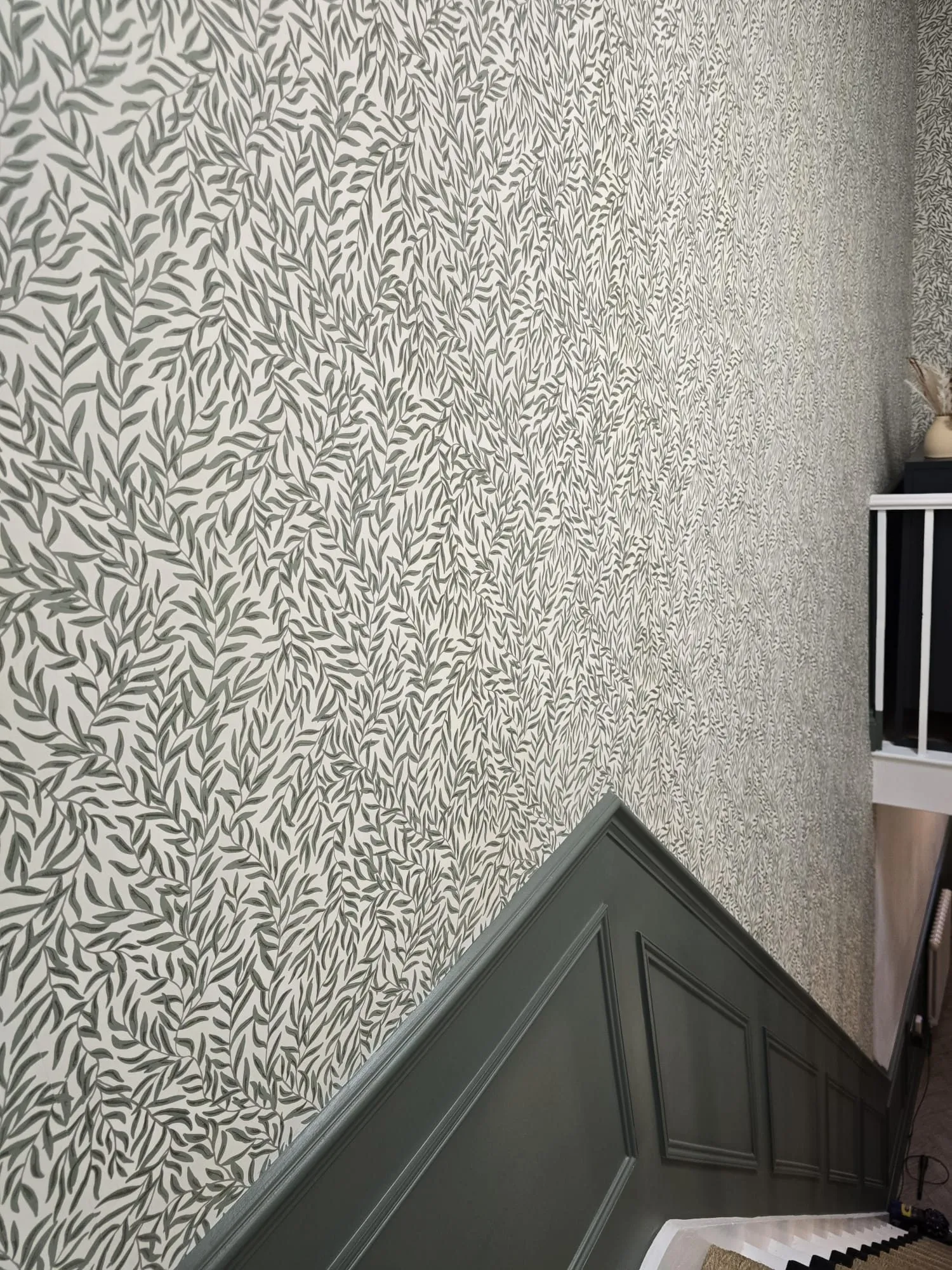
This hallway and landing has a grey-green willow-leaf paper above panelling painted charcoal. The panelling follows the stairs up at the angle of the handrail, and the paper fills everything above it to the ceiling.
The customer’s Google review (May 2025) said the wallpaper was “slightly more tricky with the design”. A small, busy leaf looks forgiving, but on a stair wall every drop is a different length, and the leaves still have to meet across each join from the hall to the landing.
It works because the dark panelling takes the knocks, and the leaf pattern hides the slight waves you find in older plaster.
2. A busy scene down a long, narrow hallway
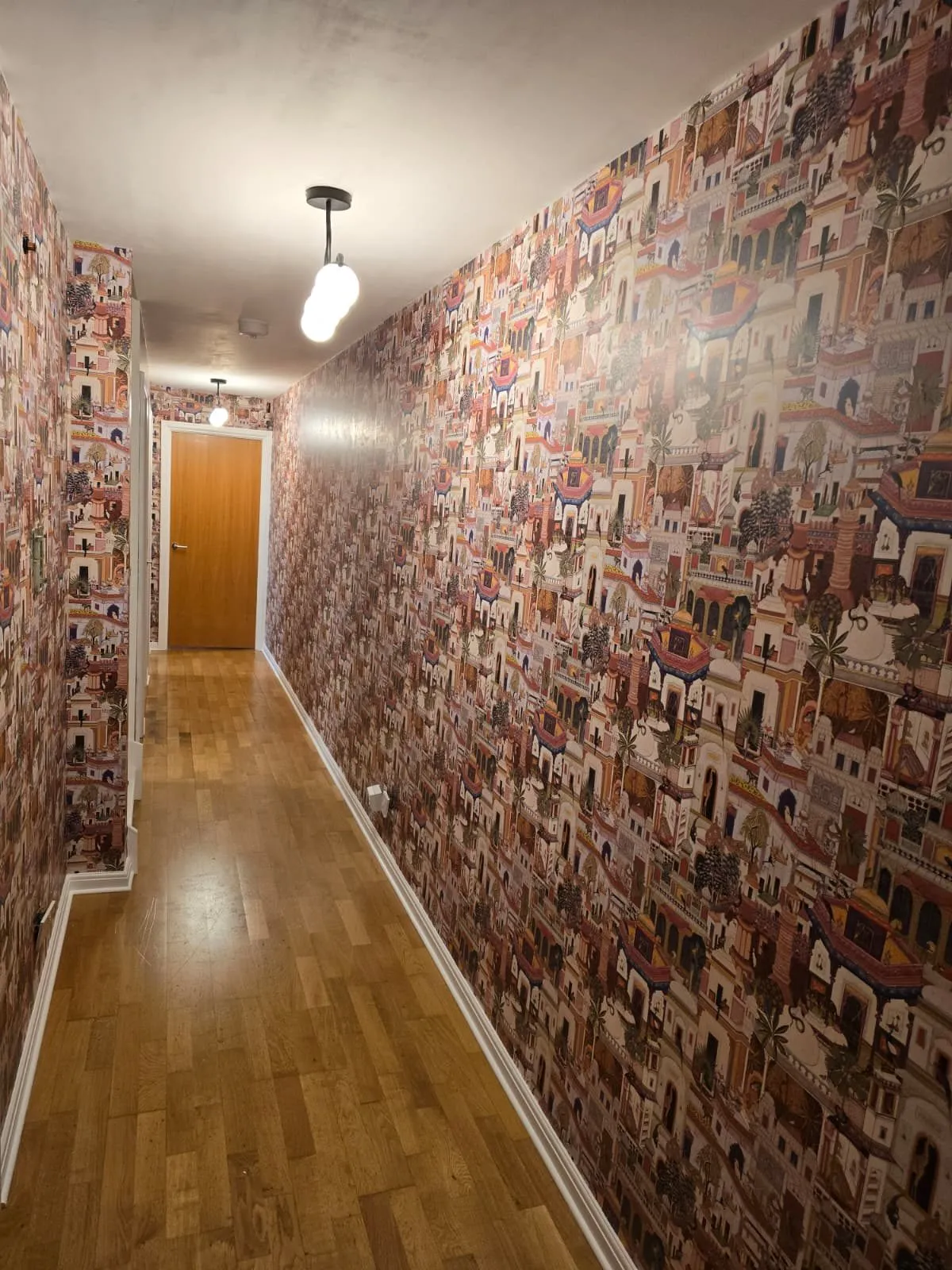
Both walls of this long hallway are papered in a colourful village-scene print, from skirting to ceiling and end to end. The floor is oak, and the skirting, ceiling and doors are left plain.
Most advice says a narrow hallway needs a pale paper. We’d say a narrow hall can take a busy all-over pattern on both walls, because there’s no plain wall left to show where it narrows.
Keep the ceiling and woodwork light so the paper is the only strong thing in the space.
3. A mural up the stairwell
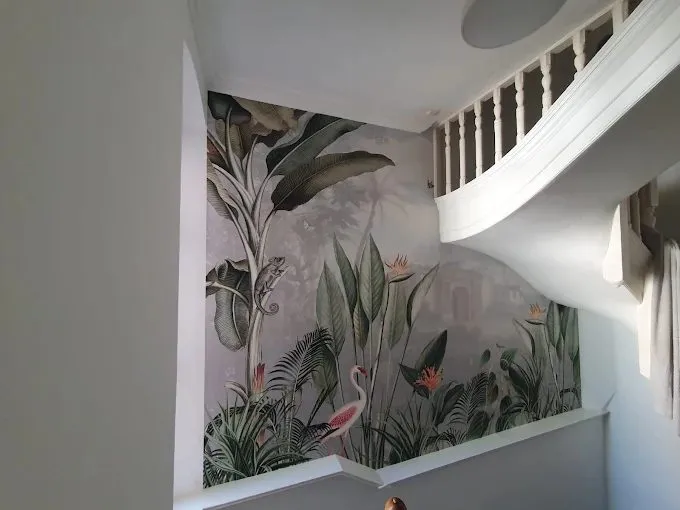
A tropical mural with flamingos, banana leaves and birds of paradise fills the stairwell wall beneath the turn of the stairs. It turns the least-used wall in the house into the first thing you see.
A mural on a stairwell isn’t a rectangle. The bottom edge follows the stairs and the top meets the underside of the flight above, so we check which part of the picture lands where before the first panel goes up.
Get that wrong and the best part of the scene ends up hidden behind the stairs. We’ve also hung a grey toile de Jouy up a stairwell and landing, which suits a period house that wants pattern without one big scene.
4. Floral paper in an arched stairwell
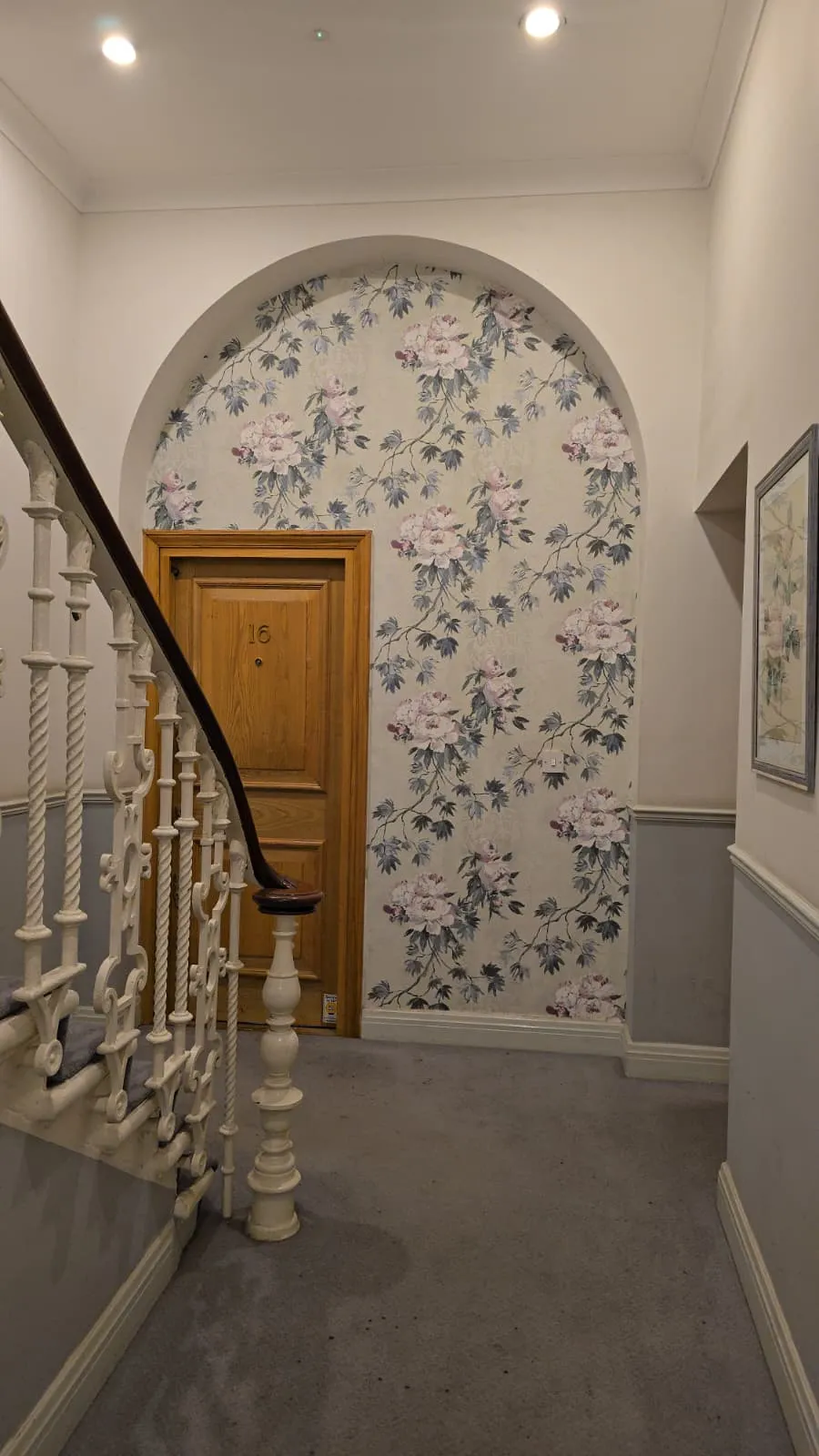
A blue and pink floral fills an arched recess at the foot of a staircase, above a lower wall painted grey with a white dado rail. The paper is cut into the curve of the arch by hand.
Arches, curves and recesses are where hallway paper most often goes wrong. A pattern with plenty of background between the flowers hides those hand-cut edges better than a tight geometric.
5. A bold print on the landing, plain paint below the dado
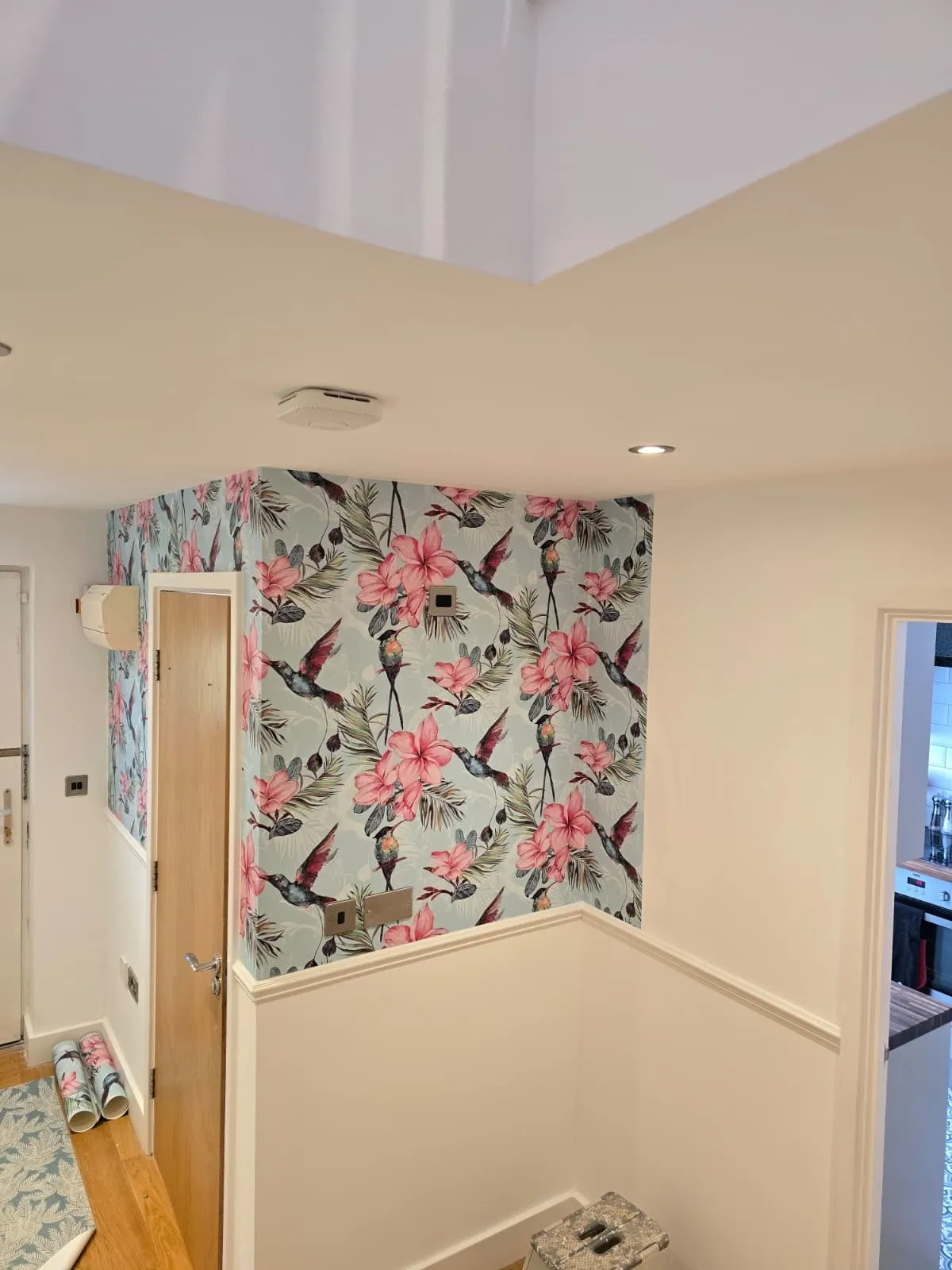
Pink hibiscus and hummingbirds on a pale blue ground, above a white dado on a landing. The walls below the rail and the ceiling are kept white.
A landing is seen from below, often from the front door, which makes it a good place for the boldest paper in the house. Keeping the lower wall painted stops it feeling heavy in a small space, and that wall can be wiped down or repainted without touching the paper.
6. A botanical paper above coloured panelling
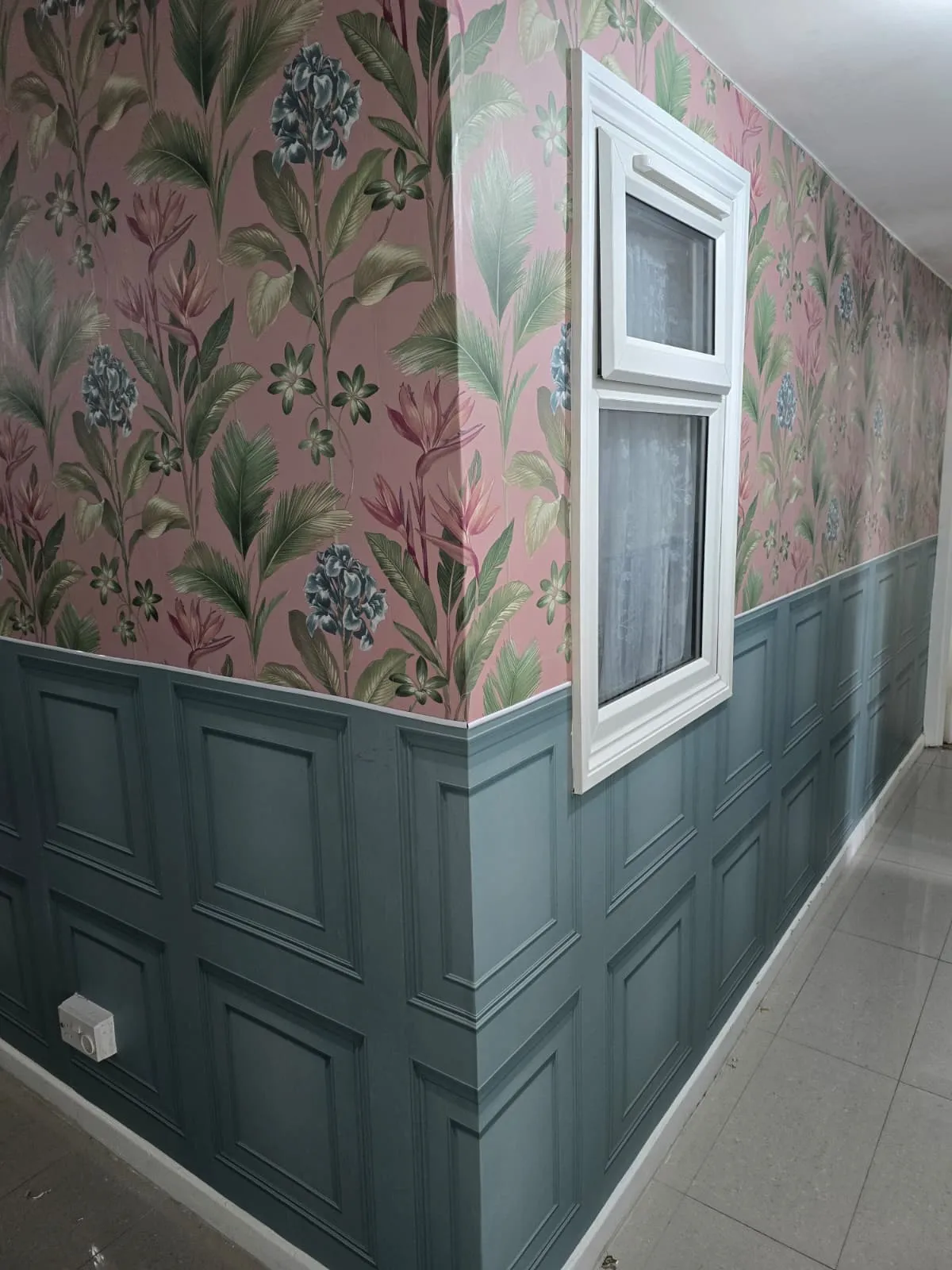
A pink botanical paper above teal painted panelling, in a corridor and around a window. The panelling colour is taken from the green of the leaves, so the two read as one scheme.
Pick the panelling paint from the paper, not the other way round. We paint the panelling and hang the paper, so the line where they meet is planned by the same team.
7. A marble-effect wallcovering under a period fanlight
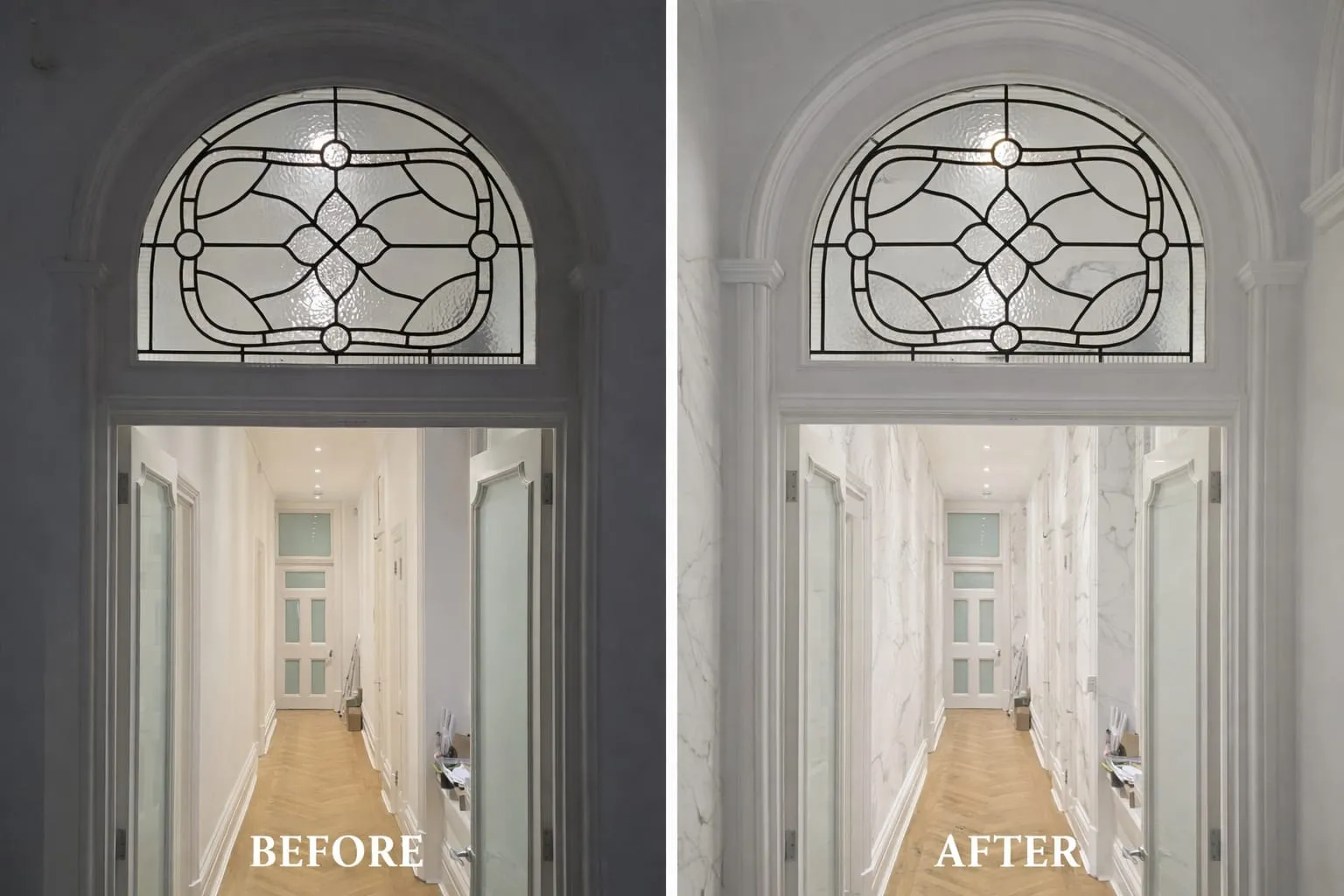
A painted entrance hall beneath a leaded fanlight, then the same hall in a white marble-effect wallcovering.
Not every hallway needs pattern. A quiet wallcovering lets the period features do the work, here the fanlight and the long view through to the back door, and it gives the walls more depth than a flat colour.
How to choose wallpaper for a hallway, stairs and landing
Check four things before you order: the pattern repeat, how washable the paper is, how it suits the width of your hall, and how flat your walls are. On a stairwell, the repeat matters more than anywhere else in the house.
Check the pattern repeat before you order
Every roll label gives a pattern repeat and a match: straight, half-drop or free. The bigger the repeat, the more paper is cut off each drop to line the pattern up.
On a room wall that waste is small. On a stairwell it isn’t: a standard UK roll is about 10 metres long, and the longest drop in a stairwell, from the landing ceiling down to the stairs, can be 4.5 metres or more.
Here’s what that does to a single roll on a 4.5 metre stair wall:
| Small repeat or free match | 64cm repeat | |
|---|---|---|
| Length cut for each drop (wall plus trimming) | about 4.6m | about 5.1m (rounded up to whole repeats) |
| Full drops from a 10m roll | 2 | 1 |
| What’s left over | about 0.8m | about 4.9m, for shorter drops higher up |
So a large-repeat paper can need far more rolls on the stairs than the same area of wall in a bedroom. Measure each drop on its own rather than working out square metres, and buy every roll from the same batch number so the colour matches.
If you’re buying your own paper, tell us the paper and how many rolls you have when you send photos. We’ll say if you need more for the repeat.
Choose a paper that can be wiped
Hallways take bags, coats, wet umbrellas and hands on the stair wall. The washability symbol on the label tells you how much cleaning the paper can take:
- One wavy line (spongeable): a light dab with a damp sponge, water only.
- Two wavy lines (washable): surface marks off with a damp sponge.
- Three wavy lines (extra washable): a wet cloth and mild soapy water.
- A brush (scrubbable): a soft brush and mild detergent.
For a hall, stairs and landing, go for washable at least, and scrubbable if bikes or a buggy live in the hall. Vinyl papers are usually tougher than plain paper or flock.
Narrow hallways: light, vertical, or bold all over
For a narrow hallway, a light background with a small or open pattern makes the walls feel further apart, and a vertical stripe or trailing design draws the eye up rather than along. The other route is idea 2 above: a busy pattern on both walls, so the narrowness has nowhere to show.
Whichever you choose, paper both side walls and keep the ceiling light. Papering one side of a narrow hall makes the plain wall look closer.
Uneven walls: which papers hide them
Busy all-over patterns, textured and heavier papers, and matt finishes hide uneven plaster best. Smooth, shiny and plain papers show every bump, and stripes or geometrics show a wall that isn’t upright, because the lines run off the vertical.
No paper hides a crack that hasn’t been filled, though.
Old paper comes off, cracks are filled and the wall is sanded smooth before anything goes up. If there’s old paper on your walls now, see our wallpaper removal service.
Period hallways and listed buildings
Many Central London hallways still have original panelling, dado rails and cornices. If your house is listed, Historic England’s listed building consent guidance says redecorating panelling doesn’t need consent, but altering or replacing panelling, dado rails and similar features generally does.
Removing old wallpaper only needs consent in rare cases, where the paper is particularly early or of high decorative quality. Check with your council before changing original features.
Where to start wallpapering on stairs
Start with the longest drop, usually on the stairwell wall where it runs from the landing ceiling down to the stairs. Hang it first, plumb, with the pattern placed where it’s most seen from the hall, then work outwards in both directions so any small mismatch ends up in a corner nobody looks at.
A few more things that matter on stairs:
- Centre the pattern on the wall you see first. Usually that’s the wall facing the front door or the stairwell wall seen from the hall.
- Use a proper platform. A long stair drop needs a safe working platform across the stairs, not a stepladder balanced on a tread.
- Two people for long drops. A pasted length of 4 metres or more is awkward to handle alone without creasing it.
- Paint first, paper last. Ceilings, banisters, skirting and doors are usually painted before the paper goes up, so no paint gets on the new paper. We do the woodwork as well, so it’s one job.
Having your hallway, stairs and landing papered
A single feature wall can be done in a couple of hours. A hallway, stairs and landing takes longer, depending on the pattern, the number of drops and how much preparation the walls need, and we tell you how long it will take before we start.
The hallway is the way in and out of the house for everyone while we work. Stairs and floors are covered before we start, and the hall is left clean at the end.
We price each hallway from the drops, the paper and the state of the walls, not a day rate. Send us one photo of the whole hall, stairs and landing, one closer shot of the walls, and the wallpaper label or product details if you’ve chosen a paper.
We can provide an initial estimate remotely from photos and arrange a site visit where required.
Still deciding between papers? Send the ones you like and we’ll tell you how each will hang on your stairs.
Get an estimate and we’ll advise on the next step.